

Longines: The Time of Elegance
Longines, a Swiss watchmaking company founded in 1832 in Saint-Imier, has a rich and fascinating history. Find out more.
Published on · Updated on | 11 minutes of reading
You may have seen Longines’ name on the various courts during major tennis tournaments, alpine skiing world championships or horse races. Let’s go back a bit to find out a little more about this Swiss watchmaking company, whose founding took place in 1832.
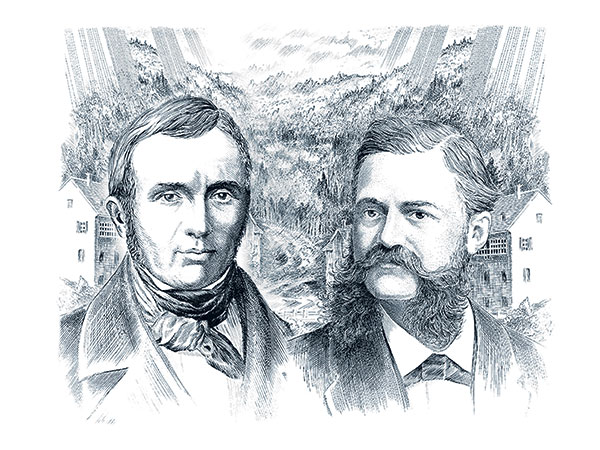
Photo: Longines
It’s in Saint-Imier, a town located in the Swiss Jura Massif, that the company was founded under the leadership of Auguste Agassiz (strange coincidence that Andre Agassi used to be a spokesperson for Longines). The young Ernest Francillon is entering a new era of industrialization without doubt or fear, which was the only way to proceed. Realizing that he needed help from someone who shared his philosophy, he led his nephew on the adventure, inviting him to join his ambitious project. With this conviction, he transformed his uncle’s watchmaking counter into a modern factory. From 1867, watchmakers worked together under the same roof, assisted by machines. The manufacture is located in the “long meadows” of Saint-Imier, which will give its name to Longines. The name Longines was always accompanied by a logo, a winged hourglass placed near the serial number from its inception. It was indeed never too early to fight counterfeit. It was a price that the founders of the brand were willing to pay.
From then on, the house developed, in 1878, its first instrument for timing sporting events: a single-push pocket chronograph. A few years later, in 1889, Longines could already measure 1/5 of a second. The 1880s marked the beginning of Longines’s glorious history of horse racing in the United States.
Charles Lindbergh and Longines Innovation
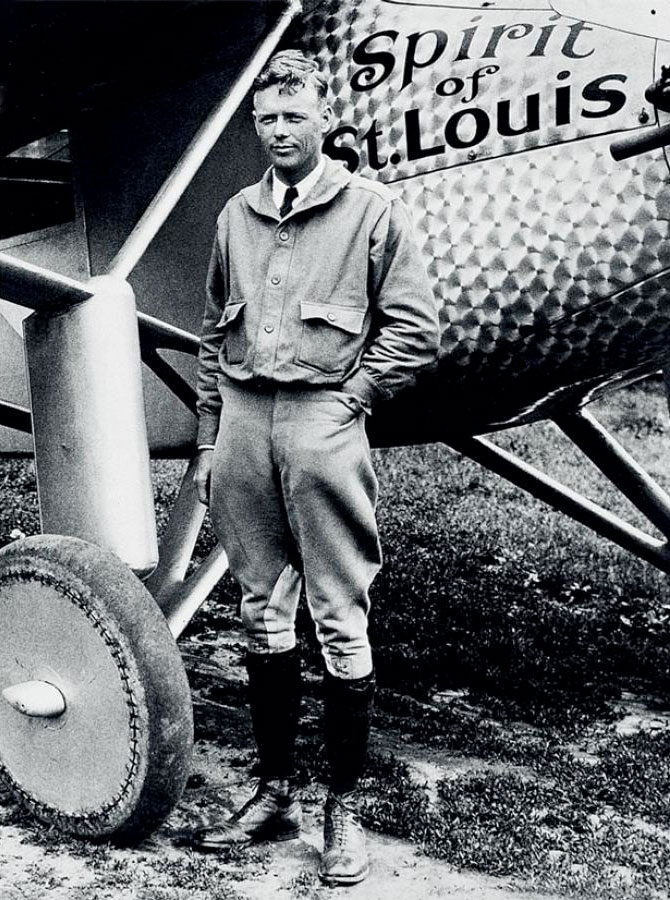
Photo: Longines
On May 20, 1927, at 7:52 a.m., Charles Lindbergh’s plane, the “Spirit of St. Louis,” loaded with 1,704 litres of fuel, crisscrossed the runway of the New York airfield before taking off slowly. The twenty-five-year-old pilot chooses to have more fuel rather than a radio. At 3:57 p.m., the “Spirit of St. Louis” wheels landed on the Le Bourget aerodrome, near Paris, after 33 hours and 30 minutes of flight, and 3,635 miles (5,850 kilometres) covered. Measured by Longines, official timekeeper of the Fédération Aéronautique Internationale (FAI), the feat is known in the history books as the world’s first non-stop single-handed transatlantic flight.
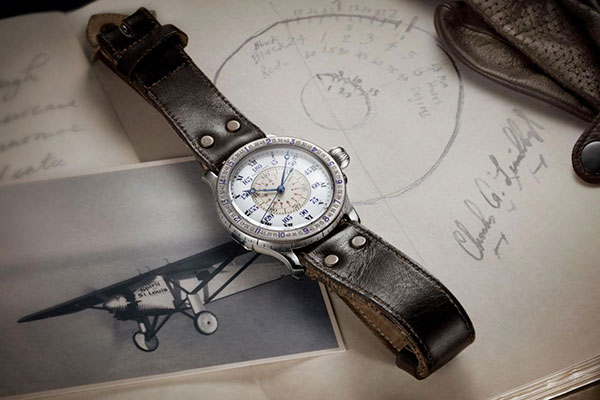
Photo: Longines
In 1928, following an accident in Cuba, Lindbergh enlisted Philip Van Horn Weems to help him improve his navigation skills. Inspired by Weems’s know-how, Lindbergh imagines a watch model that would serve as a true air navigation instrument capable of calculating longitude and exact geographical location. The creation of this tool watch, equipped with a rotating bezel to measure the hour angle of the sun as well as a central dial, also rotating, is entrusted to Longines.
First produced in 1931, it was called the “Lindbergh Hour Angle Watch.” It established itself as an indispensable tool for a whole generation of pilots, navigators and pioneers on their voyages to conquer the skies.
Philip Van Horn Weems: The Man Who Changed Everything.
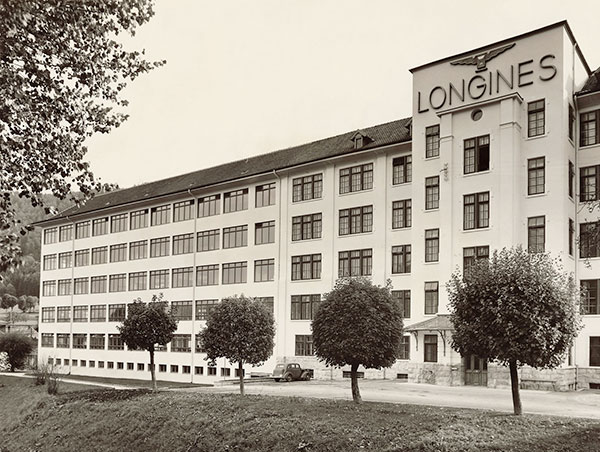
Photo: Longines
Coming back to Philip Van Horn Weems, the latter is a naval officer, instructor and inventor. In the 1920s, air navigation was difficult and often imprecise, and resulted in several pilots being killed. It was then that Weems put his naval experience into the service of pilots by founding the Weems School of Navigation, where many influential aviators learned essential skills.
One of these, of whom we spoke to you above, Charles Lindbergh, joined Weems in 1928 to learn astronomical navigation. Before 1927, the watches can only be adjusted down to the minute. However, a 4-second deviation on a watch could cause an aircraft to deviate a mile from its course, depending on its speed. In 1927, Weems perfected a watch that synchronized perfectly with the time signal broadcast to the nearest second without stopping the movement. Thanks to an internal rotating disc equipped with a graduated scale from 0 to 60 seconds, obtained the synchronization.
Longines, a recognized specialist in the pilot’s watches and official supplier to the Fédération Aéronautique Internationale, began producing a “second adjustment” model in 1929. That same year, Mr. Weems filed a patent for an instrument that could be synchronized with a signal broadcast by a central dial or bezel, both rotating. Made by Longines, the watches created by Lindbergh and Weems are the first on the planet to be fitted with a rotating bezel. In August 1931, the Longines Weems Second-Setting Pilot Watch was adopted by the US Air Force, becoming an integral part of the pilots’ equipment until 1946. And this is how Longines forged a reputation as a leader in the world of aeronautics.
Longines: First at the Finish Line
Long before Formula 1 existed, Longines timed its first motor competition — the 1933 Brazilian Grand Prix.
In the first Formula 1 season in 1950, Longines clocked the famous Monaco Grand Prix and the Indy 500 in the United States. A few years later, the Saint-Imier brand was present at the Formula 1 Grands Prix in Barcelona, Bern, Buenos Aires, Zandvoort, Spa-Francorchamps and Melbourne, as well as many other races and hill climbs.
In addition, to improve the accuracy of its systems used at sporting events, Longines introduced the electronic quartz clock in 1954. Building on this know-how, Longines launched one of the very first quartz wristwatches in 1969.
In the years that followed, Longines engineers once again perfected timing by measuring the individual time of each car. This new system, developed in collaboration with Olivetti, the Italian technology company, makes it possible to identify cars using radio waves, a world first. The Formula One Constructors’ Association (FOCA) homologated and officially presented this revolutionary timing process in the United States Automobile Grand Prix at Long Beach in March 1980. The electronic pulses transmitted by the Longines encoders fitted to each car sent data to the car’s computer extremely fast, broadcasting information in real-time to teams, the media and the public. Between 1982 and 1992, Longines was the official timekeeper of all Formula 1 races. The Swiss brand also became sponsors of the Ferrari and Renault teams over the years.

Photo: Longines
Beyond the racetrack, Longines is also present on the ski slopes. From the creation of its first chronograph model in 1878 to the present day, Longines has always been a pioneering figure in timekeeping. Driven by its spirit of innovation and its interest in the world of sports, the brand has been associated with alpine skiing since the early 20th century. It all began in 1924 when, for the first time, Longines provided timing equipment for a ski race organized by the army, not far from its manufacture in Saint-Imier, Switzerland.
Leveraging its timekeeping expertise, Longines is now the premier partner of the International Ski Federation (FIS). The brand has also secured an active participation in winter sports as Official Timekeeper of the FIS Alpine Ski World Cup and the FIS World Championships.
Equestrian Sports and Longines Linked in Their Existence
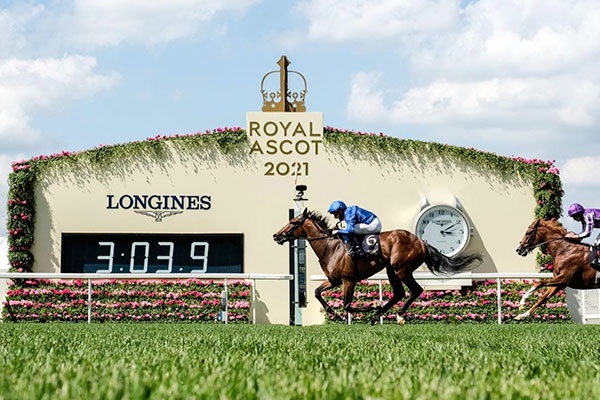
Photo: Longines
Horses have always had a special meaning for Longines. Indeed, Saint-Imier, the brand’s head office, is also the only Swiss horse breed’s cradle, the Franches-Montagnes horse. It is no surprise that many of Maison’s pocket watches are enhanced with equestrian motifs. The oldest of these watches dates back to 1869. Longines produced its first equestrian-themed watch just two years after having created its manufacture. This timepiece inaugurates a long series of equestrian pocket watches, a heritage that the brand proudly reinterprets with The Longines Equestrian Pocket Watch collection.
The first pocket watches also respond to the pioneering brand’s commitment to equestrian sports. As early as 1878, Longines had already developed its first chronograph movement, placed in an engraved case with a jockey and its mount. These chronographs appeared on American racetracks as early as the 1880s, where they were particularly popular with jockeys and horse enthusiasts. In 1912, the brand sponsored a show jumping competition in Lisbon, Portugal, thus creating a link between Longines and the equestrian world, which continues to this day.

Photo: Longines
The watchmaker has been involved in horse riding since its inception. In particular, because of the common values that their two worlds have in common. On the one hand, both have a strong tradition, and on the other, Longines and horse enthusiasts appreciate elegance. Whether they are wild, training for competitions or accompanying their owners during their leisure time, horses have the particularity of enhancing the elegance of those around them, just like Longines watches. These are an example of the style for those who put them on their wrists. Finally, in both cases, performance is a source of motivation. In addition, let us not forget that countless equestrian races have benefited from the quality and reliability of the chronographs and instruments developed by Longines to time the most spectacular exploits over the years.
Longines learned a lot while working in professional watchmaking, then transferring this know-how to wristwatches. For example, the movement, the watch’s heart, has often had to be redesigned and miniaturized. The company’s watchmakers were true pioneers. The latter producing the first wrist chronograph in 1913, the first high-frequency pocket chronograph oscillating at 36,000 vibrations per hour in 1929 (cal. 18.72), the world’s first wristwatch with a rotating bezel in 1931 and the first pocket flyback chronograph, patented in 1936. And since then, innovations have constantly been guiding the transformation by Longines.
90 Years of the Flyback Chronograph
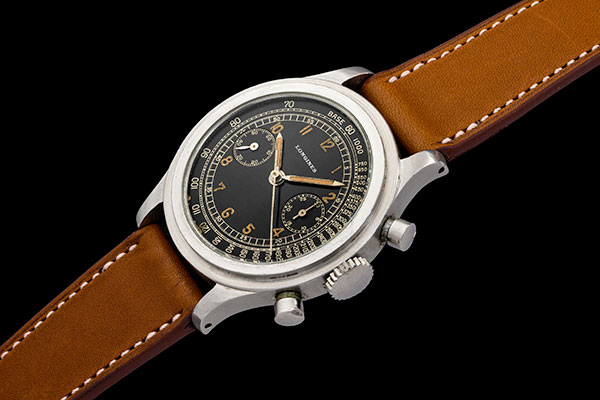
Photo: Longines
On 16 June 1936, Longines was granted a patent for its flyback chronograph, an invention by the Swiss watchmaker that revolutionized timekeeping and the management of the various stages of a flight. By setting new standards in time measurement on board an aircraft, this mechanism—featuring two independent pushers—has inspired generations of pilots’ watches and remains one of the major advances in the history of chronographs.
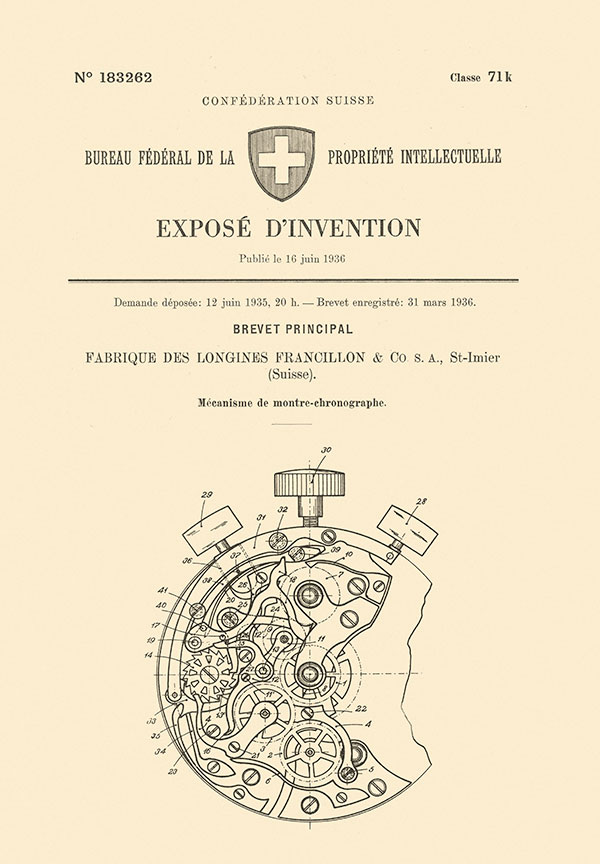
Photo: Longines
Preserved in the brand’s archives, the original drawings bear witness to a mechanism destined to influence the design of professional chronographs thanks to its ability to stop, reset and restart the seconds hand with a single press. This eliminates the need to perform each action separately whilst in flight, thereby reducing the risk of human error whilst speeding up decision-making and real-time course corrections.
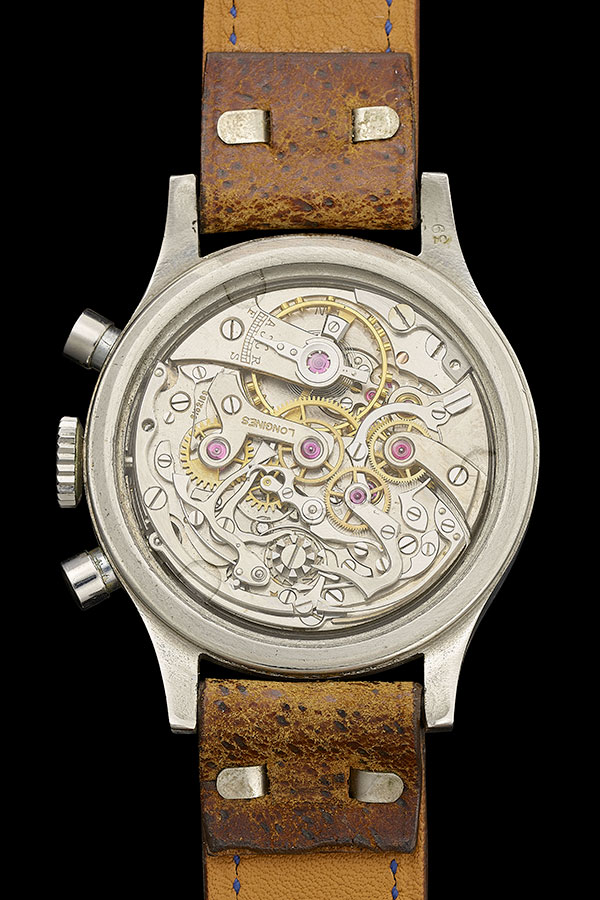
Rhodium-plated 13ZN movement, matt silver dial with
telemetric and tachymetric scales, in excellent condition,
a striking example of Longines’ watchmaking expertise.
Photo: Longines
Even today, its influence and legacy live on in the Longines Spirit Flyback and Longines Spirit Pilot Flyback collections. It is this 90th anniversary that we are celebrating by publishing this article online today, 16 June 2026—exactly 90 years after the patent was granted.
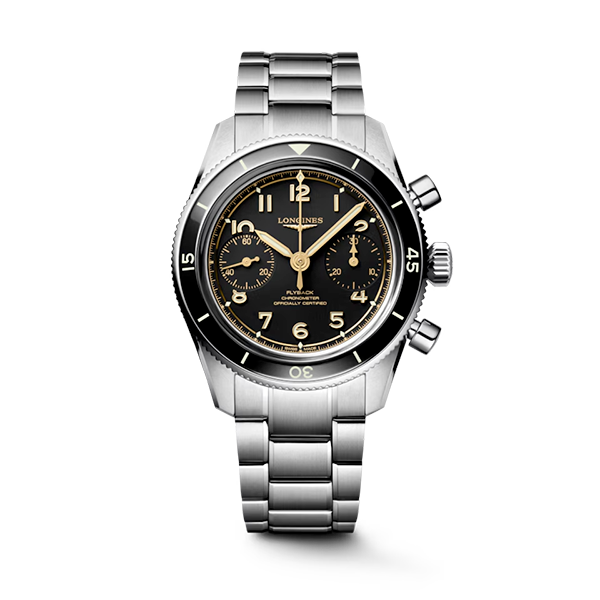
Photo: Longines
Do consider adding this 2025 model to your Father’s Day gift list.
Article originally published in Gentologie Magazine Issue 8.

Note: When we learn that an error has slipped into our site, we report it by correcting it. If you notice an error, please inform us by contacting us through our Contact us page.