
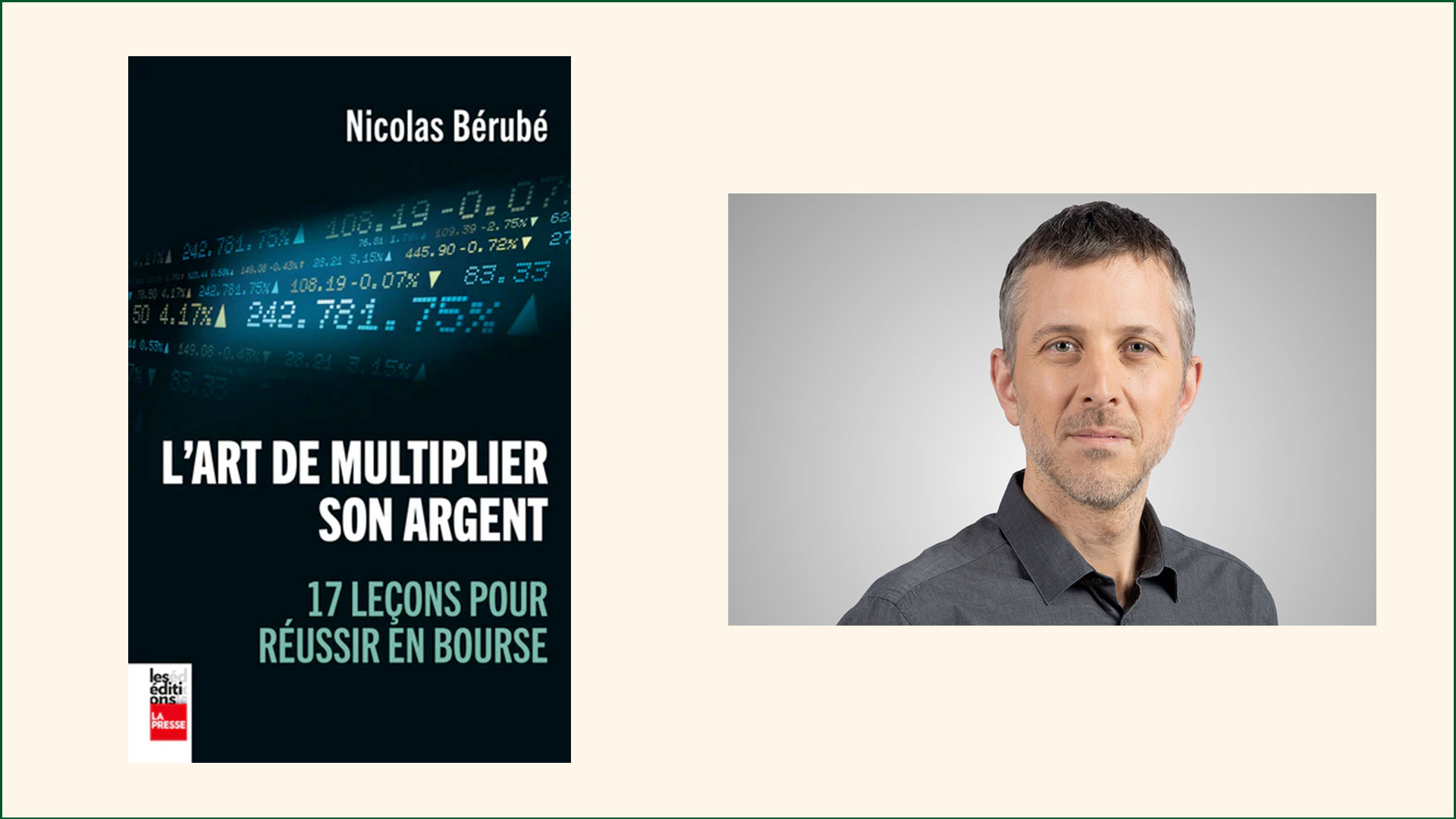
L’art de multiplier son argent book by Nicolas Bérubé: Back to the future
Published on | 10 minutes of reading
Talking with Nicolas Bérubé, a journalist at La Presse, is almost like talking to an old friend. I say almost, because we have never met in person, but we have corresponded several times, and I also interviewed him for his second book, “De zéro à millionnaire : investir en bourse sans souffrir” (“From Zero to Millionaire: Investing in the Stock Market Without Suffering”). Now I’m interviewing him a second time, for what the logical follow-up to his second book is, “L’art de multiplier son argent : 17 leçons pour réussir en bourse” (“The Art of Multiplying Your Money: 17 Lessons for Success on the Stock Market”).
Is Québec still uncomfortable talking about money?
Yes, this book is designed for people living in the Québec province, and Mr. Bérubé addresses right away a problem that we have in Québec, especially among Francophones, and more specifically those who have been in the province for several generations: the embarrassment of talking about money and the fact that people are not very interested in financial literacy, when they should be. . . And for those who think this book is about getting rich quick, you couldn’t be more wrong. This quote (translated) from the foreword sums up the author’s point of view.
“I can’t tell you how to get rich quickly; I can only tell you how to get poor quickly:
by trying to get rich quickly.”
—André Kostolany, author and stock market expert
A Guide to Québec Finances
Perhaps, like me, your high school economics classes are a distant memory. Mr. Bérubé says he receives more than 20 questions a week, regardless of the time of year (often following his column “L’argent et le bonheur” (“Money and Happiness”) published every Sunday in La Presse), and finds it unfortunate that few people in the public sphere are impartial and disinterested. These columns and books have had a snowball effect, with people wanting to know more. For example, “Should I invest in the US stock market in US dollars? Should I only buy stocks and not bonds because stocks have a better return?” explains the author. As many of his readers’ questions were repetitive, he decided to put it all into this new book. He points out that this book is aimed at an audience that is already convinced they want to invest, not at convincing those who are unsure.
L’art de multiplier son argent book (The Art of Multiplying Your Money): An Unbiased Book
What I like about this book is that it doesn’t benefit the author in any way, other than the sale of the book itself, of course, whereas most financial advice benefits its sellers, who, sometimes intentionally or unintentionally, hide the truth about the fees and actual money you spend on their services. “People sometimes ask me if I get paid because I often recommend investing in exchange-traded funds (ETFs), but investing in them is like a nutritionist telling you to eat more vegetables and exercise (. . .). It’s based on studies they’ve seen that show it’s better to eat carrots than chocolate, and for me, it’s the same thing. I base my recommendations on what the research tells us. I don’t recommend any specific product. What I do is much more about education,” adds Mr. Bérubé.
Is the author himself a millionaire?
Although he sidesteps the question directly, the author opens up a lot about his personal journey, whether it’s the fact that he made more money during his time as a correspondent in the United States in the early 2000s, or the fact that he doesn’t have a luxury car or a luxury cottage in the Laurentians. “The advantage of being 48 years old is that I’ve been interested in finance for over 20 years. My time in the United States, with a significant salary increase, allowed me to start investing part of my income, knowing that this status would be temporary. Not to mention my exposure to the financial markets while I was in California, which I believe was not as popular in Quebec,” adds the journalist. He also points out that, for many Quebecers, investing means investing in real estate. However, this is becoming less and less true today, as demonstrated by the 2008 crisis in the United States, where home values fell by nearly 30%.
He also adds that he became interested in Warren Buffett, known as the Oracle of Omaha, who did not fit the typical profile of a traditional investor seeking quick profits, but seemed like a simple person with a long-term perspective.
L’art de multiplier son argent book (The Art of Multiplying Your Money) : Tips to Apply Every Day
Still referring to Mr. Buffett, he tells us that these teachings, and the fact that his companies’ profit margins have been lower in recent years, have prompted him to take a look at studies and research to explore other avenues. “Unfortunately, there are a lot of people in this industry who try to scare us by saying, ‘It’s risky, etc.,’ and the underlying message is: trust me with your money,” says Mr. Bérubé. I would add that these are dishonest people who want to make money with your money.
There is a myth that Mr. Bérubé talks about, which is that people think they only pay fees on their returns, but they pay fees on the entire amount invested. And you’re going to have to pay those fees, whether your returns go up or down, the journalist points out.
He also points out that many people in Canada invest with their bank, which is not very reassuring, since many advisors often have little knowledge and their sales objectives often take precedence over customer service. “Financial advisors often claim that you will pay 2.5% in fees, but if this year’s return is 5%, minus 2.5% and 2.5% inflation, you’ll be in the same position you were 12 months ago. And I’m not sure everyone understands that clearly,” adds our guest. He also points out that an amendment to a law will detail all bank fees on your investments on an annual basis starting in 2026. According to Mr. Bérubé, and I tend to believe him, financial institutions seem to be capitalizing on the fact that most people are not that interested in their finances.
17 lessons for success in the stock market: Hard-earned personal lessons?
You’re probably wondering where these lessons come from. Some, without going into detail, come from bad experiences, while others are questions the author asked himself. “The lesson I like to talk about is “the better the story, the emptier your pockets,” which is quite difficult to understand. For example, a reader tells me, ’I’m 20 years old and I only invest in technology companies because I believe that technology will become increasingly important in the years to come. It’s a good idea, but stock market prices already factor that in. If people think they can get ahead of the curve because they have this idea, many others had it before them. It’s not an idea that will yield exceptional returns. Historically, studies have shown that sectors that are strong in one decade are no longer strong in the next,” adds Mr. Bérubé. He also tells us that people often invest by looking in the rearview mirror rather than looking through the windshield. “It’s normal, it’s human nature, but we have to break this habit because we need to invest for the future, not the past, since most funds will decline rather than continue their climb to the top,” says the author.
Political Influence
Many people are tempted to invest in the United States, but the author reminds us that Canadian funds outperformed U.S. funds from 2000 to 2010. “In 2020, people no longer wanted to invest in the United States because the country was in turmoil, there are only crises there, etc., and the phenomenon is repeating itself,” the author explains. He also tells us that, with the tariffs imposed by the president south of the border, some companies are being devalued based on the future decline in their sales in the US market. In short, we understand why the latter sometimes declines rapidly, because the market does not like this kind of turmoil.
Can anyone invest?
Some of you may find investing in the stock market elitist, especially in these particularly difficult times for a growing segment of the population, but what Mr. Bérubé is saying is that someone in debt should pay off their debts before investing. “In the same vein, look at Trudeau Airport, it’s overflowing, same thing at the Cage and the Bell Centre. Even when it comes to cars, it’s not the majority of people who drive a Toyota Yaris. And if we look at Canadian statistics, 30% of people earning $250,000 or more are not maximizing their TFSA (Tax-Free Savings Account),” adds the veteran journalist. The advice they give, he says, is based on where people are in their lives, their salary range, etc. The author of “The Art of Multiplying Your Money: 17 Lessons for Success in the Stock Market” points out that all these people, regardless of their income, need help to avoid pitfalls, find the right products, and know what to do to secure their children’s future.
A Book With a Lot of Content
At nearly 330 pages, the book might seem daunting to some, but that’s not the case. Like Mr. Bérubé’s previous books, it’s a page-turner. And to keep it from being “boring,” as he says, the addition of graphics helps with the visual understanding of certain concepts. “There are 17 lessons, so each chapter is fairly short, and the visuals give the book breathing room so that it’s always enjoyable to read,” concludes the author.
Happy reading!
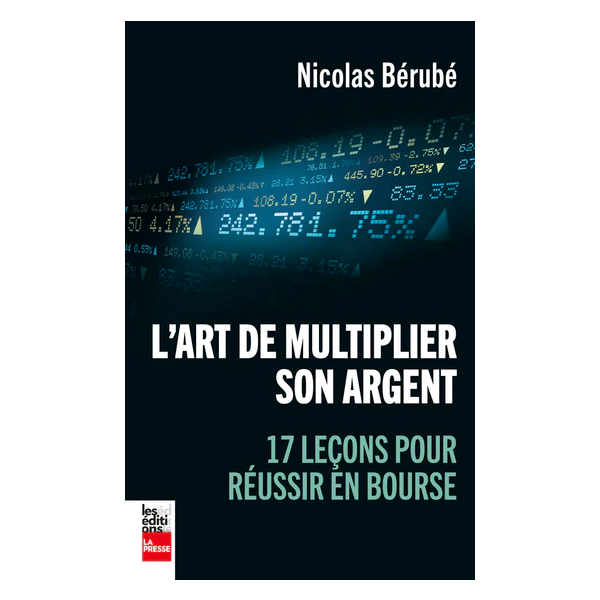
L’art de multiplier son argent : 17 leçons pour réussir en bourse book on Les Éditions La Presse
Buy nowShare the post "L’art de multiplier son argent book by Nicolas Bérubé: Back to the future"
Note: When we learn that an error has slipped into our site, we report it by correcting it. If you notice an error, please inform us by contacting us through our Contact us page.