

I recently watched the Québec film François·e, the first mainstream film about being transgender. It’s written by Gabrielle Boulianne-Tremblay and Jean-François Léger, directed by Jean-François Asselin, and stars Louis Morissette in the title role (he’s also a producer alongside Louis-Philippe Drolet), Pascale Drevillon, Geneviève Schmidt, Cassandra Latreille, Rachel Graton, and Robin Aubert. This work, released in early July, floored me. Here’s why I loved this film and why everyone should go see it. I’m thinking of you in particular, gentlemen.
François·e, or a Mirror to Masculine Contradictions
To sum up the story: François, a screenwriter on the decline, sees his life (and his house) falling apart, and decides, on a form, to check off “transgender” to secure funding.
Fortunately (or unfortunately for François), it works. He then has to transform himself and become Françoise, an author in transition. From that moment on, a shift in perception among his loved ones becomes apparent. His ex-wife and daughter behave differently toward him.
François’s biggest challenge, however, is that he doesn’t know the codes of the series he’s writing. To ensure authenticity in his screenplay, he forms an alliance with Sarah, a true trans writer, portrayed masterfully by Pascale Drevillon.
As he dives headfirst into the project, he doesn’t realize his lies are trapping him either. Everything seems to be going well for François: the money, the relationships. Everything is perfect, but he’s walking a tightrope, and everything can—and will—tip to the wrong side.
I say contradiction because, while everything looks fine on the outside for François, inside, things are far from okay. And that says a lot about us men. As François looks at himself from the outside as Françoise, he comes to understand all his flaws and how differently others perceive him. A sad reality.
A Funny and Touching Film
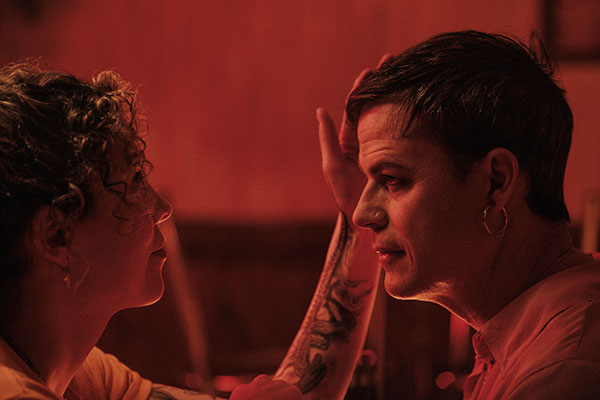
Photo: Danny Taillon
The film moves effortlessly between genuinely funny moments and more uncomfortable scenes, a contrast that’s clearly intentional, whether it’s with Daniel, the garage mechanic played by Robin Aubert, or the hockey dressing room, a true echo chamber of masculinity. It’s hard not to laugh at this pitch-perfect recreation of a Pretty Woman scene: a real gem of art direction.
The hockey dressing room scene I mentioned above is also worth discussing further, as acceptance of change sits at the heart of how the people François has known for years suddenly shift their perception of him entirely once he becomes Françoise.
Another moment that strikes a nerve is the assault and the exchange with police officers, who don’t seem to take Françoise’s report seriously. It’s easy to imagine this may be drawn from a real experience lived by the co-writer.
The clinic scene strikes a nerve too, and is a reminder of just how difficult the medical path remains for trans people. The RAMQ ([The Régie de l’assurance maladie du Québec (RAMQ) administers public health and drug insurance plans and pays health professionals] and likely every health authority on the planet) would do well to better support this reality. There’s a real sense of closeness in the scene, feelings beyond friendship developing between the two main characters, even leading to a kiss.
But beneath the humour and tenderness, the film never loses sight of where it started: the lie François checked off on a form to secure funding.
This mechanism is at the core of the film: a funding system that pushes a screenwriter out of ideas to lie about his identity to save his career. The subject is unsettling, and rightly so—a screenplay, no matter how good (unlike the first version François submitted), should be able to stand out on its quality alone, regardless of the identity of the person who wrote it. The film raises an unavoidable question: does a project really need to check an identity box, or come from someone already known, to be taken seriously.
Rather than imposing quotas, a more promising path, in my view, would be mentorship: sponsorship programs where experienced voices in the field — in writing, screenwriting, acting — support up-and-coming talent from diverse backgrounds, without sidelining anyone else in the process. A way to broaden the creative community through openness and inclusion, rather than obligation.
The Reality of the Film François·e and Men
You only need to visit the social media accounts of actor and producer Louis Morissette to realize that a lot of us, I mean men here, aren’t doing well.
From the moment the trailer dropped in April 2026, well before the film’s release, controversy was already brewing. And since then, plenty of people, mostly men who haven’t seen the film (!!!), have been lashing out violently and disturbingly, insulting the actor in the title role as well as the trans community as a whole. Morissette himself had to speak out publicly to condemn the tone of some comments, which went well beyond legitimate criticism of a work of fiction.
What’s striking is how backwards it all is: the film, co-written with trans author Gabrielle Boulianne-Tremblay and led by the beautiful trans actress Pascale Drevillon, was actually well received by the trans community itself. So the source of the discomfort lies elsewhere. And that “elsewhere,” gentlemen, is us.
How to Be a Good Ally
I’ll admit that, before seeing the film, several of the codes shown on screen went over my head (I should admit I don’t have any trans people in my immediate circle, and I rarely cross paths with any), and some still do.
It’s perfectly natural to sometimes not know how to behave or what to do. After all, less than 2% of the population is trans, which means it’s rarely part of most people’s day-to-day lives, but it’s very much present nonetheless. For some, that’s confronting, and it’s okay to admit that. You need to know how to put words into what you’re experiencing. Difference often scares people, but there’s a way to express that which doesn’t hurt anyone.
One way to grow, to understand, is simply to ask questions when the moment and the relationship allow for it. And it’s completely normal to make mistakes, not to know all the vocabulary: it might not be your everyday reality, but that doesn’t mean you can’t learn to understand it better.
Getting someone’s name or pronoun wrong happens, even with the best intentions. The difference between an ally and someone who hurts without meaning to often comes down to how they recover: simply, without turning it into a drama that shifts attention back onto themselves rather than the person in front of them. You correct yourself, you carry on, and you remember for next time.
Being an ally also doesn’t mean waiting to have all the answers before acting. It means listening more than you speak, not letting a joke or a demeaning comment slide in a hockey dressing room or anywhere else, even when it’s easier to laugh along with the group, as we also discussed in this article about women.
And sometimes it’s as simple as going to see a film like François·e with an open mind rather than judging it by its trailer.
If this topic resonates with you and you’d like to learn more, organizations like Aide aux Trans Québec or Interligne offer information and a listening ear for trans people and for those around them looking to better understand.
As of this writing, the film François·e is still in theatres—let’s help make it a hit.
Share the post "Why Should All Men Watch the Movie François·e?"
Note: When we learn that an error has slipped into our site, we report it by correcting it. If you notice an error, please inform us by contacting us through our Contact us page.